

Outdoor lighting for restaurant and hospitality venues: complete 2026 guide
Why outdoor lighting matters for restaurants
A restaurant terrace serves several purposes at once. Guests need to read menus and see their companions, while staff need clear routes between tables, doors and service stations. A bright façade alone does not meet those needs.
Hospitality venues also rearrange furniture, clean surfaces and close outdoor areas after service. Lighting needs to support those tasks without making the dining setting feel like a work area. Your should therefore distinguish dining light from circulation and cleaning light.
Inspyerlighting offers designer indoor and outdoor fittings, but product selection does not replace a site lighting design or an electrician's assessment. Start with the venue's requirements, then match the fittings to them.
How to plan outdoor lighting for restaurants
Map your entrance, dining and service zones
Start with a printed plan or a hand-drawn sketch. Mark the guest entrance, host position, table layouts, steps, kitchen access and neighbouring windows before considering individual products. Walk the space after dark as well as during daylight.
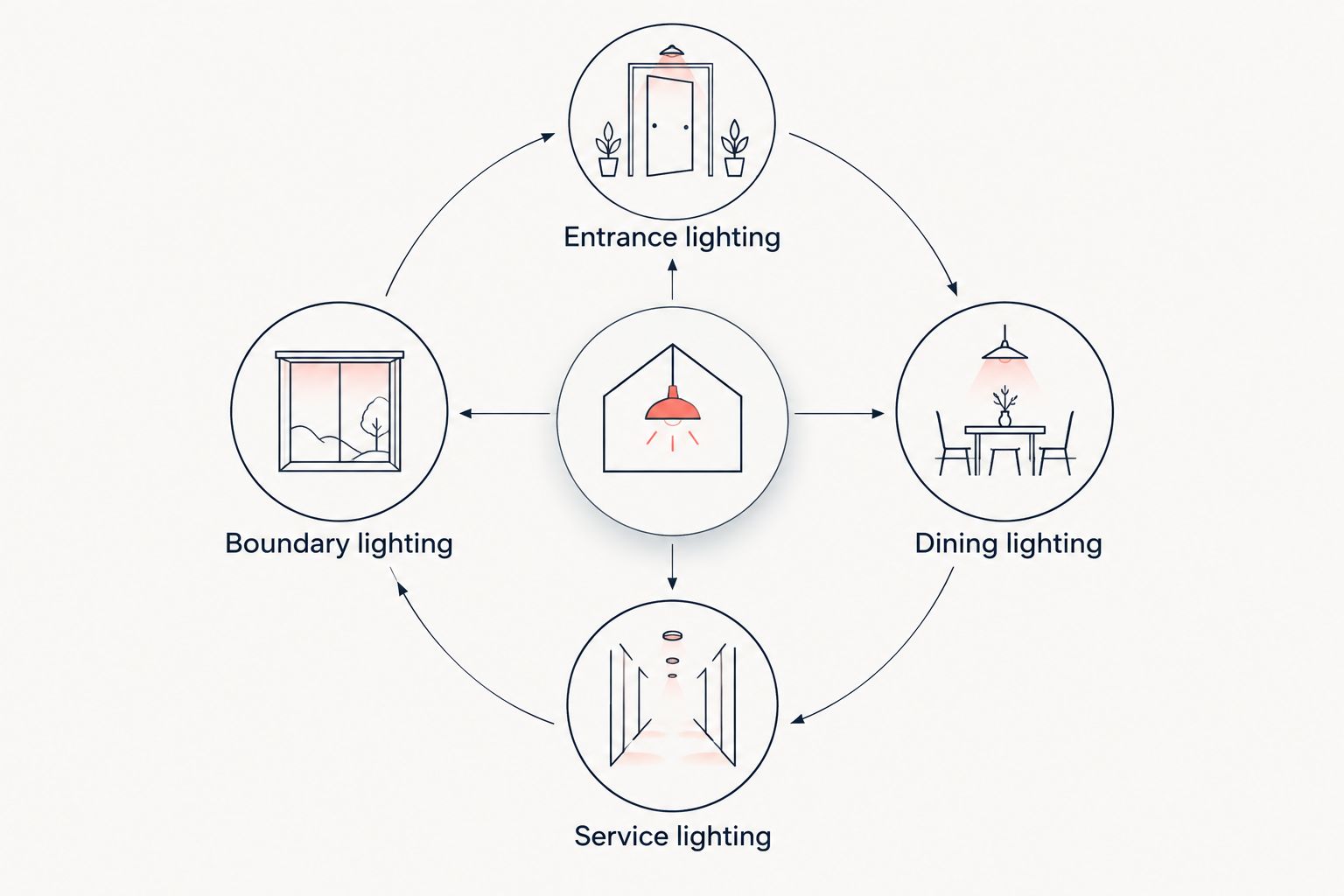
Treat entrance lighting, dining lighting and service lighting as separate requirements. The entrance should make the destination clear; dining light should support conversation and menus; service light should reveal the working route. One decorative pendant cannot solve all three.
Keep planting and façade lighting separate from these essential functions. A lit tree adds depth, but it does not establish whether a server can see a change in level beside a table. Identify those gaps on the plan before adding decorative accents.
- Entrance lighting: mark doorways, signage and the host position.
- Dining lighting: draw tables, chairs and occupied seating positions.
- Service lighting: trace staff routes and access to clearing stations.
- Boundary lighting: record nearby homes and reflective glazing.
Measure your tables, canopy and mounting positions
Use a tape measure to record table dimensions, canopy height, available wall space and the distance between fittings and seated guests. Include doors, awnings and heaters on the same drawing.
There is no single pendant size or hanging height that suits every terrace. A fitting over a fixed dining table has different clearance needs from a fitting above a route that staff cross carrying trays. Show both conditions to your installer.
For your specification, record measurements and photograph each proposed mounting point. This gives the designer and electrician a shared reference rather than a collection of loosely labelled inspiration images.
- Measure table lengths, widths and the occupied chair footprint.
- Record canopy height and the proposed suspension position.
- Check door swings, folding awnings and heater clearances.
- Mark mounting surfaces and accessible cable routes.
- Photograph the view from each seated position.
Match protection to the actual exposure
Assess the exact location, not just the word outdoor in a product name. A wall beneath an overhang, an exposed terrace edge and a fitting near cleaning equipment face different conditions. Ask your installer to assess water exposure, connections and mounting arrangements together.
The IP code on products describes enclosure protection under IEC 60529. IP44 includes protection against splashing water; IP65 includes dust-tight protection and protection against water jets; IP66 covers dust-tight protection and powerful water jets. An IP rating does not establish corrosion resistance or suitability for every cleaning method.
Layer table light with wall and route lighting
Start by identifying what your existing fittings illuminate. Stand at the entrance, sit at a table and walk the staff route. Keep useful light where it already works, then address the gaps rather than replacing everything with brighter fittings.
Wall lights provide fixed lighting positions around the terrace perimeter. Outdoor pendants create an overhead focus where a suitable support exists. Portable outdoor lamps allow placement to follow furniture, but introduce a handling routine. Each approach solves a different problem.
Control glare and choose a consistent colour appearance
Test lighting from the guest's seated eye level, not just from the doorway. A fitting that looks comfortable when you stand beneath it can expose a bright source when you sit across the terrace. Check reflections in glass, polished tables and windows too.
Colour temperature describes light appearance, not brightness. A 2700 K source looks warmer than a 3000 K source; a 4000 K source looks cooler than both. These are comparison points, not mandatory restaurant specifications. Review samples alongside upholstery, table finishes and food presentation.
Prioritise a comfortable view over a dramatic fitting. A pendant's shape is only part of the decision: source visibility, diffuser design and placement determine what guests actually see. Judge the lit sample, not only the product photograph.
- View each proposed fitting from seated and standing positions.
- Check whether guests can see the light source directly.
- Compare colour-temperature samples beside interior lighting.
- Examine reflections in glazing and glossy tabletops.
- Keep the colour appearance consistent within each dining zone.
Plan controls around the service routine
Write down how staff should operate the terrace lighting before selecting a control system. Opening, dining service, clearing and closing require different actions. Separate circuits or control groups should reflect the venue's actual zones rather than an arbitrary division of the building.
For a 2026 refurbishment, review existing wiring and controls with the electrician before ordering replacements. A fitting described as dimmable still needs the correct driver, control method and installation. Do not assume a familiar wall dimmer works with every outdoor light.
Portable lamps need an equally clear operating plan. Decide who places them, where they are stored and how rechargeable models are managed where applicable. Flexible placement is useful only when the staff routine supports it.
- Define opening, dining, cleaning and closing settings.
- Group entrance, dining and service lighting separately.
- Verify the exact fitting, driver and control combination.
- Label controls with plain names that staff recognise.
- Assign responsibility for portable lamp handling and storage.
Trial the layout during an evening service
Use a sample fitting or a temporary arrangement approved by your installer before committing to a repeated layout. Check an occupied table, not an empty terrace. Guests, chairs, coats and serving trays change both sightlines and access.
Ask staff to carry out normal tasks: greet arrivals, present menus, serve dishes and clear tables. Check the terrace from the neighbouring boundary as well. A design that works from the restaurant entrance can still produce intrusive light elsewhere.
Record specific changes rather than asking whether the space feels bright enough. Note a visible source, a dark step or a cable conflict and identify the position involved. This creates a practical snagging list for the final installation.
- Test menu reading from every seat at the sample table.
- Walk staff routes while tables are occupied.
- Check glare towards adjacent properties and upper windows.
- Repeat the test with doors and awnings in normal positions.
- Record adjustments to placement, aiming and control settings.
Compare outdoor lighting options for your venue
Choose the fitting type by its job first. The options below identify useful applications and the design constraint you must resolve; they are not substitutes for checking dimensions, photometric information and installation requirements.
| Option | Best for | Main benefit | Key limitation or check | |
|---|---|---|---|---|
| Flos Clessidra Outdoor Wall Light | A terrace brief requiring fixed wall fittings | Uses a wall-mounted position rather than table space | Establish light distribution before relying on it for dining tables | |
| Flos Flauta Spiga Outdoor Wall Light | Coordinating outdoor wall fittings with an architectural scheme | Provides another outdoor wall-light option for the shortlist | Confirm dimensions, output and controls for the exact version | |
| Louis Poulsen AJ Eklipta Outdoor Wall / Ceiling Light | A brief seeking a softly luminous wall or ceiling surface | Glass designed to provide a uniformly lit surface | Diffuse appearance does not establish illumination at distant tables | |
| Roger Pradier Place des Vosges 1 Tradition Outdoor Wall Light | A traditional wall-light brief requiring splash protection | Aluminium fitting with IP44 rating and clear or frosted glass diffuser | IP44 is not a water-jet rating | |
| Bover Nans Plug-In Outdoor Pendant Light (S/16/H) | An overhead dining-light brief suited to a plug-in arrangement | Outdoor pendant format with a plug-in connection | Resolve suspension, cable routing and the electrical connection before selection |
These four products offer distinct starting points: a diffuse outdoor wall or ceiling fitting, two wall lights with different ingress ratings, and a plug-in outdoor pendant. Confirm the chosen variant and installation requirements before ordering.
Outdoor lighting to consider

Outdoor wall or ceiling light with glass designed to provide a uniformly lit surface.
£400

Aluminium outdoor wall light with IP44 rating and clear or frosted glass diffuser.
£228

Diffused direct/indirect-light wall lighting with an IP55 rating
£348

Outdoor plug-in pendant offered with graphite brown red, brown or beige shade.
£357
Common lighting mistakes restaurant venues make
Treating a covered terrace as an indoor room
A canopy does not establish that an indoor fitting is suitable beneath it. Assess wind-driven rain, cleaning and the electrical installation. Specify the exact outdoor version where the assessment requires it, rather than relying on a shared collection name.
Lighting the building but leaving the tables unresolved
Façade lighting and dining lighting have different purposes. Check menus and faces at the tables before adding more architectural accents. If the shortfall is on the tabletop, address that location instead of simply increasing wall-light output.
Selecting pendants before fixing the furniture plan
A pendant positioned for one table arrangement can conflict with the next. Establish the layouts used for ordinary dining and private events before fixing suspension positions. Preserve clear routes when tables move, especially beneath low canopies.
Assuming dimming or portability removes operational work
Dimming requires a verified control arrangement, while portable lamps require staff handling. Include both in the operating brief. A flexible product is not automatically a low-maintenance solution for a busy evening service.
Letting the terrace spill light into neighbouring properties
Check the view beyond the venue boundary before approving the scheme. Reduce unnecessary outward light through placement, shielding and aiming where the fitting permits it. Set the closing routine so decorative lighting does not remain on without a purpose.
FAQ
What's the best outdoor lighting for restaurants?
The best outdoor lighting for restaurants combines clear entrance and service-route lighting with comfortable dining light. Choose wall lights, outdoor pendants or portable lamps according to the layout and exposure rather than expecting one fitting type to cover every task.
What IP rating do restaurant terrace lights need?
The required IP rating depends on the fitting's exposure and installation position. IP44 covers splashing water, IP65 covers water jets and IP66 covers powerful water jets, but your installer must also assess connections, mounting and environmental conditions.
Can I use indoor pendant lights beneath a restaurant canopy?
A canopy alone does not establish that an indoor pendant is suitable outdoors. Check the exact product's permitted use and have the installer assess rain, cleaning exposure and the electrical arrangement.
Is 2700 K or 3000 K better for an outdoor dining area?
2700 K looks warmer than 3000 K; neither is automatically better for every restaurant. Compare samples beside the interior lighting, table finishes and food presentation before choosing a consistent colour appearance.
Are outdoor wall lights enough to illuminate restaurant tables?
Outdoor wall lights are enough only when their distribution and placement provide suitable light at the tables. Check the occupied seating layout and menus after dark rather than judging brightness from the wall.
Are portable outdoor lamps better than fixed lighting?
Portable outdoor lamps suit layouts that change, while fixed lighting provides permanent mounting positions. Portable lamps introduce handling and storage requirements; fixed fittings require planned wiring and do not move with the furniture.
Can every outdoor LED light work with a dimmer?
No, outdoor LED lights do not all work with the same dimmer. Verify the exact fitting, driver and control method together before ordering or connecting the installation.
One last thing
Approve the terrace from a guest's chair, not from the entrance. For your project, photograph the same table from seated eye level during the evening trial and after installation. The comparison exposes visible light sources, reflections and furniture changes that a wide architectural photograph conceals.
Use Inspyerlighting's outdoor lighting selection to complete the specification only after that test. A well-chosen fitting belongs in a working layout, not just an attractive product shortlist.